
26 min read

How companies can remain future-ready within planetary boundaries and leverage market opportunities. Risks, regulatory requirements, and concrete action recommendations.
The Planetary Health Check 2026, published on 21 September 2026, confirms a troubling reality: Seven of nine planetary boundaries have been crossed, and all seven are at their highest recorded level. For companies, this means the end of incremental sustainability approaches.
"We do not have the luxury of time, but we do have the knowledge, capacity and solutions to change course."
Johan Rockström, Director, Potsdam Institute for Climate Impact Research, on the Planetary Health Check 2026
Where the Nine Boundaries Stand in 2026: Control Variables and Current Values
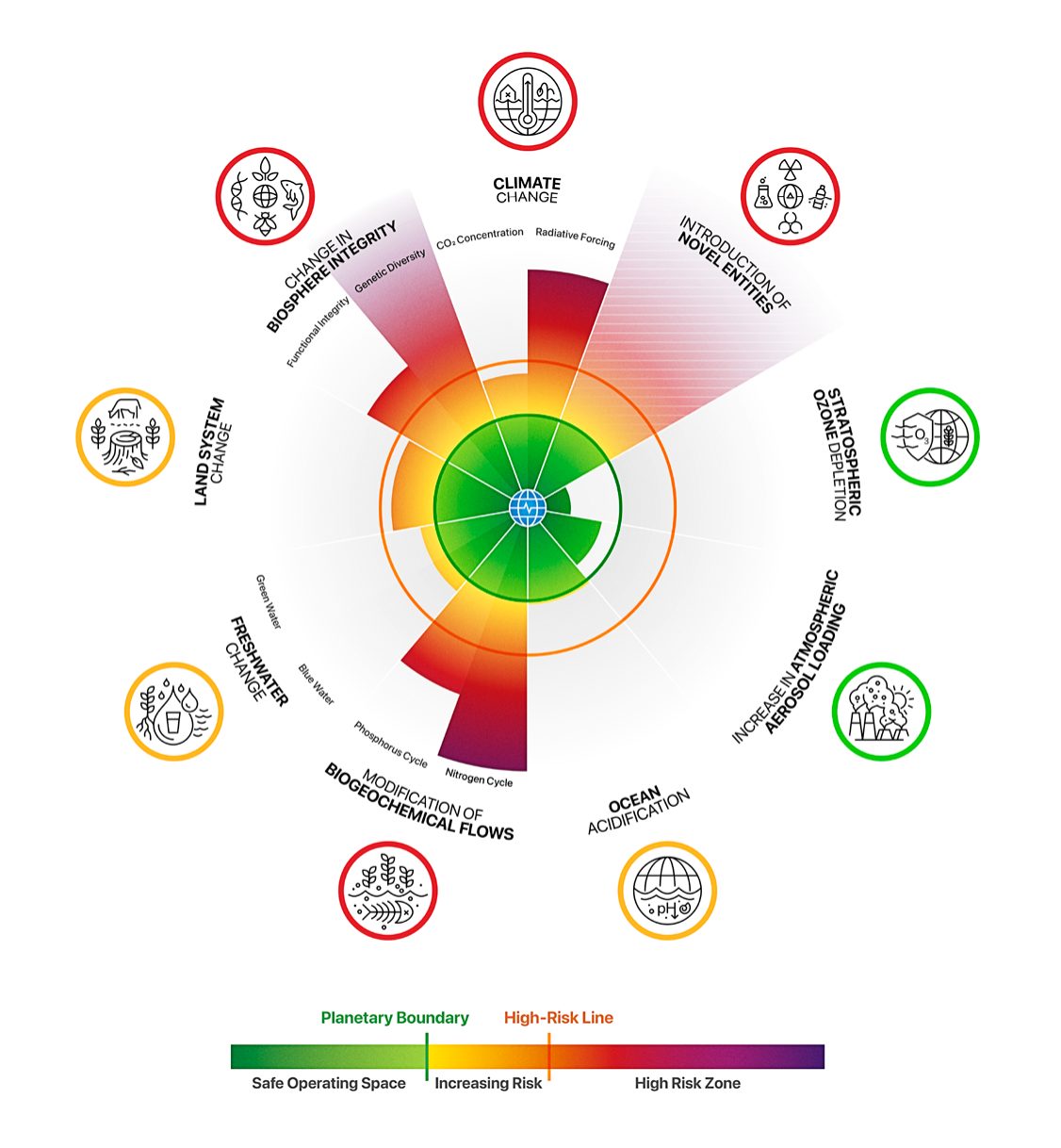
Status as of October 2026. The most recent assessment is the Planetary Health Check 2026, published by the Potsdam Institute for Climate Impact Research on 21 September 2026. It keeps seven of the nine planetary boundaries (PB) outside the safe operating space for humanity and finds all seven at their highest recorded level of transgression. Each boundary is measured through a control variable, a single quantity that can be tracked over time, and each control variable is judged against the Holocene reference state, the roughly ten thousand years of relative Earth system stability in which agriculture and every human civilisation developed. The check is published annually, so the register below is dated rather than permanent.
What has changed since the framework was first published:
2009, first framework: three boundaries transgressed, climate change, biosphere integrity and biogeochemical flows.
2015, first major update: four transgressed, land-system change added.
2023, first quantification of all nine: six transgressed, freshwater change and novel entities added.
2025, Planetary Health Check: seven transgressed, ocean acidification added.
2026, Planetary Health Check: still seven transgressed, all at their highest recorded level, none back inside the safe zone. The values in the table are those of the last full quantification; the 2026 report confirms the direction for each of them.
| Boundary | Control variable | Boundary value | Current value | Zone |
|---|---|---|---|---|
| Climate change | Atmospheric CO2 concentration | 350 ppm | above 420 ppm | Transgressed |
| Biosphere integrity | Extinction rate, plus human appropriation of net primary production (HANPP) | Below 10 extinctions per million species-years; HANPP at most 10 % of pre-industrial production | Above 100 extinctions per million species-years; HANPP around 30 % | Transgressed |
| Land-system change | Forested land remaining, as a share of original forest cover | 75 % | around 60 % | Transgressed |
| Freshwater change | Ice-free land area with blue water (streamflow) and green water (soil moisture) deviating from pre-industrial conditions | 10.2 % blue water, 11.1 % green water | around 18.2 % blue water, around 15.8 % green water | Transgressed |
| Biogeochemical flows | Nitrogen and phosphorus applied to land | 62 Tg nitrogen per year, 11 Tg phosphorus per year | around 190 Tg nitrogen per year, around 22.6 Tg phosphorus per year | Transgressed |
| Ocean acidification | Aragonite saturation state of surface seawater | At least 80 % of the pre-industrial value | Below that threshold since the 2025 assessment | Transgressed, most recent addition |
| Novel entities | Synthetic chemicals, plastics and other engineered substances released without adequate safety assessment | No release beyond what safety testing can cover | No single global figure exists, the boundary is judged exceeded on qualitative grounds | Transgressed |
| Atmospheric aerosol loading | Interhemispheric difference in aerosol optical depth | 0.10 | around 0.076 | Within the safe zone |
| Stratospheric ozone depletion | Stratospheric ozone concentration | 276 Dobson units | around 285 Dobson units | Within the safe zone, recovering |
Two readings of this table are wrong in ways that matter for planning. The first is to treat a transgressed row as a switch that has been thrown. The framework does not describe tipping points, it describes a zone of increasing risk: transgression means the probability of large, non-linear Earth system responses begins to climb, not that an irreversible event has already occurred. The second is to treat the two rows still inside the safe zone as spare capacity. Stratospheric ozone sits inside its boundary because of four decades of the Montreal Protocol, and aerosol loading sits inside its boundary largely as a side effect of air quality regulation that was written for human health, not for Earth system stability.
A parallel line of research, the safe and just Earth system boundaries, adds a minimum-harm criterion for people to the stability criterion used above. Where the two are compared, the just boundary is the stricter of the pair. That difference is worth knowing before a company reads any figure in the table as a target it is entitled to reach rather than as a ceiling it should stay well below.
What Decision-Makers Need to Know:
-
Systemic Crisis: Seven of nine planetary boundaries are now beyond their safe operating space
-
Financial Exposure: Companies unprepared for planetary transformation face material profit risks by 2050
-
Regulatory Response: CSRD, EU Taxonomy, and EUDR represent policy responses to planetary boundaries science
-
Market Opportunity: €107.5 billion in revenue from environmental protection goods and services in Germany in 2022, up 16.9% (Destatis)
-
Strategic Shift: Transition from relative efficiency to absolute sustainability targets
Live data on the market side of this picture, green bond volumes, CSRD benchmarks and EU ETS prices, is updated automatically in the Fiegenbaum Atlas dashboard.
What the 2026 Report Adds
The Planetary Health Check 2026, written by more than 60 scientists at the Potsdam Institute for Climate Impact Research, crosses no new boundary but finds no recovery in any of the seven. Four findings matter for companies:
Land carbon sinks are stalling. The uptake of CO₂ by forests and soils has stagnated for decades, and separate research warns of a tipping risk in the Amazon, from carbon sink to carbon source. Net-zero plans that lean on natural sinks or offsets carry more risk than they did a year ago.
Novel entities outpace assessment. Around 350,000 synthetic chemicals are already in circulation and roughly 2,000 are added every year, faster than safety testing can follow.
Aerosol loading is safe globally, not everywhere. The boundary holds on average, while South Asia remains beyond safe limits with a worsening trend.
All seven transgressed boundaries are at their highest recorded level. In the words of lead author Boris Sakschewski: “Pressure is rising across every Planetary Boundary already outside the safe operating space.”
Ocean Acidification: The Newest Danger Zone
The intensifying acidification stems primarily from fossil fuel emissions being absorbed by the oceans. Since the start of the industrial era, surface ocean pH has fallen by about 0.1 units, a 30 to 40% increase in acidity (Planetary Health Check 2025), threatening marine life including tiny sea snails (pteropods), tropical coral reefs, and Arctic marine life. The economic implications are substantial: the ocean provides goods and services worth at least $2.5 trillion a year, supporting coastal fisheries and tourism (WWF, Reviving the Ocean Economy, 2015).
Business Impact Beyond Fisheries: The ocean acidification boundary breach affects more than fishing industries. Weakened coral reefs reduce natural coastal protection, exposing infrastructure to storm damage. For property and infrastructure on exposed coasts, that is a physical risk to carry in the climate risk analysis, not only a fisheries topic.
Understanding Scientific Uncertainties and Risk Dynamics
Critical Context on Planetary Boundaries Framework: Crossing a planetary boundary doesn't trigger immediate catastrophe, but fundamentally alters risk profiles. The Nature study establishing the planetary boundaries framework emphasises these represent "safe operating spaces" rather than cliff edges. However, the scientific consensus from the Potsdam Institute for Climate Impact Research and Stockholm Resilience Centre is clear: distance from safe limits correlates with exponentially increasing unpredictability in Earth system responses.
The planetary boundary control variables are designed as early warning signs. Uncertainty about tipping points and their timing remains high, complicating corporate risk management. This doesn't diminish urgency, it amplifies it. The breached boundaries indicate we're operating in a high risk zone where cascading effects between planetary systems become increasingly probable.
Success Stories Prove Transformation is Achievable
Despite the severity of several planetary boundaries being breached, the stratospheric ozone layer recovery offers pragmatic optimism. The Montreal Protocol, ratified by every UN member state, demonstrates that coordinated global action on planetary boundary processes can succeed. This international agreement:
-
Is expected to prevent up to 2 million skin cancer cases a year by 2030, according to UNEP
-
Has achieved measurable ozone layer regeneration, with recovery to 1980 values projected around 2040 for most of the world and around 2066 over the Antarctic (WMO/UNEP Scientific Assessment of Ozone Depletion 2022)
Similar successes include European urban air pollution reductions and water quality restoration in major river systems. These examples prove that with appropriate alignment of science, policy, and business innovation, even complex planetary health challenges can be addressed systematically.
Expert Perspectives: Scientific Consensus, Strategic Divergence
Climate Impact Research Institutions
Potsdam Institute for Climate Impact Research (PIK): Warns of potential "irreversible destabilisation of the Earth system" through cascading tipping points. Their Earth System Analysis research indicates that breaching multiple planetary boundaries simultaneously could trigger non-linear feedback loops. However, PIK emphasises remaining windows for effective action through rapid decoupling of economic development from environmental degradation.
World Economic Forum (WEF): Highlights the central role of corporations. Their Nature Risk Rising report quantifies $44 trillion of economic value generation dependent on nature, whilst maintaining that 1.5°C pathways remain achievable through systemic business model innovation.
WWF One Planet Business Framework: Positions planetary boundaries science as "the most reliable compass on the path to a stable and secure future," demanding integration into core business strategy. Less alarmist than academic institutions, WWF focuses on solutions, emphasising that planetary guardians in the corporate sector can still prevent the most dangerous climate and ecological outcomes.
Concrete Business Risks: Quantifying Exposure
Physical risks from breached planetary boundaries are already manifesting with measurable economic impact. Extreme weather events caused at least €145 billion in damages across Germany between 2000 and 2021, according to a study by Prognos and partners for the German Federal Ministry for Economic Affairs and Climate Action. Bank of England stress testing shows substantial financial system exposure to these risks.
Industry-Specific Vulnerabilities
Supply Chain Exposure: Trading partners outside the EU can be more exposed to climate impacts, particularly in regions where multiple planetary boundaries are simultaneously breached.
Production Operations: The International Labour Organization projects that heat stress will cost 2.2% of total working hours worldwide in 2030, a productivity loss equivalent to 80 million full-time jobs (ILO, Working on a warmer planet, 2019).
Financing Conditions: ESG ratings increasingly reflect planetary boundaries alignment. Spreads between high and low ESG-rated corporate bonds show up in financing costs, with sustainability reporting frameworks becoming material to capital costs.
Systematic climate risk analysis becomes essential strategic risk management, particularly as the TCFD recommendations, now carried forward in the ISSB standard IFRS S2, become mandatory in a growing number of jurisdictions.
Strategic Relevance by Organisation Type
Startups: Planetary Boundaries as Market Differentiation
For startups, planetary transformation creates significant market opportunities. IRENA and the ILO counted at least 16.6 million renewable energy jobs worldwide in 2024 (Renewable Energy and Jobs, Annual Review 2025). German companies generated €107.5 billion from environmental protection goods and services in 2022, up 16.9% (Destatis), demonstrating substantial market traction for business models aligned with planetary boundaries science.
If you want to go deeper: Turning Biodiversity Loss into Business Opportunities: A Guide to Nature-Positive Strategies.
Action Recommendations for Startups:
-
Integrate planetary health considerations into ESG strategy from inception
-
Adopt Science-Based Targets as business strategy foundation
-
Develop circular economy business models
-
Utilise Germany's declining-balance depreciation of up to 30% for movable assets acquired by the end of 2027
SMEs: Strategic Compliance Within Planetary Constraints
Medium-sized enterprises face expanding regulatory requirements with constrained resources, and they often see climate transformation as a burden while overlooking the market opportunities in solutions that respect planetary boundaries.
Action Recommendations for SMEs:
-
Prepare through a systematic materiality analysis: after the Omnibus, mandatory reporting applies only above 1,000 employees and €450 million turnover, but customers and banks ask smaller firms for the same data, usually in the VSME format
-
Assess Scope 3 emissions relevance, as these are often the largest share of total emissions
-
Integrate suppliers for value chain transparency
-
Identify energy efficiency projects with short payback periods
-
Leverage industry cooperations for scale effects in addressing multiple planetary boundaries
Corporations: Systemic Transformation as Competitive Advantage
International corporations can deploy planetary boundaries framework as strategic scaffolding for business model innovation. Global presence enables scalable solutions with measurable impacts on planetary systems.
Action Recommendations for Corporations:
-
Develop regenerative business models creating positive contributions to planetary health, targeting net-positive impact by 2030
-
Implement absolute CO₂ budgets instead of intensity targets, aligning with SBTi Net-Zero Standard
-
Integrate biodiversity impact into investment decisions, recognising $44 trillion economic value depends on nature
-
Roll out circular economy strategies across product lines
-
Position planetary stewardship as brand differentiation
Venture Capital: Planetary Boundaries in Investment Decisions
VCs face expanded evaluation criteria driven by planetary boundaries science. Limited partners increasingly demand ESG integration and impact reporting, with signatories to the UN Principles for Responsible Investment reporting $121 trillion in assets under management in 2021. The Task Force on Nature-related Financial Disclosures (TNFD) extends the focus beyond climate change to nature across land, freshwater, ocean and atmosphere.
Action Recommendations for VCs:
-
Expand ESG due diligence with planetary boundaries assessments
-
Define impact KPIs for portfolio management reflecting multiple planetary boundaries
-
Support Article 8/9 classification through science-based criteria aligned with planetary health objectives
-
Enhance LP reporting with planetary impact measurements using frameworks like SASB
-
Evaluate climate tech investments through the planetary boundaries framework
Where climate capital went in 2025: Climate tech venture and growth investment rose 8% to $40.5 billion in 2025 while the number of deals fell 18%, according to Sightline Climate. Energy was the largest vertical at 36% of the total, driven by power demand from AI, and the financing gap for first-of-a-kind (FOAK) plants is now the sharpest bottleneck. VCs seeking returns must demonstrate how portfolio companies reduce physical tonnes of CO₂ or restore biodiversity at hectare-scale, not merely measure planetary impacts.
Regulatory Landscape: Science Informing Policy
Breached planetary boundaries inform, but don't solely determine, regulatory developments. Policy responds to planetary boundaries science alongside social pressure, economic interests, and international agreements. Neither the Paris Climate Agreement nor the Global Biodiversity Framework adopted at COP15, a non-binding COP decision, mentions planetary boundaries explicitly, but their goals map onto the climate change and biosphere integrity boundaries.
CSRD: Climate Risk Analysis under ESRS E1
Under the Corporate Sustainability Reporting Directive, companies for which climate change is material report on climate-related physical and transition risks under ESRS E1. ISO 14090/14091 is not prescribed, but it is a common method for that analysis. Since Directive (EU) 2026/470 the obligation covers only companies with more than 1,000 employees and more than 450 million euros in turnover. Materiality Assessment for SMEs: From ESG Compliance to Growth becomes central compliance element, assessing both company impacts on planetary boundaries and financial consequences from breached planetary boundaries.
More on this point: ISO 14091: The Essential Guide to Climate Risk Analysis for Companies.
Lessons from the first ESRS reports: EFRAG analysed around 650 sustainability statements for financial year 2024 in its State of Play 2025. About 70% of preparers commit to a 1.5 °C pathway for Scope 1 and 2, but only about 40% of those extend the target to Scope 3. The gap sits exactly where primary data is hardest to get: in the value chain.
EU Taxonomy: Science-Based Sustainability Criteria
The EU Taxonomy integrates planetary boundaries as one scientific framework amongst several into evaluation criteria for sustainable economic activities. Reporting companies disclose the share of turnover, CapEx and OpEx aligned with the technical screening criteria, not alignment with planetary boundaries. The taxonomy covers activities representing 80% of EU greenhouse gas emissions, providing technical screening criteria informed by climate impact research and planetary health assessments.
EUDR: Addressing Land System Change
The EU Deforestation Regulation directly addresses the breached land system change boundary. Companies must prove raw materials don't originate from deforested areas, which affects EU imports of commodities like palm oil, soy, coffee, and cocoa.
EUDR timeline: After two postponements, the regulation applies to large and medium-sized operators from 30 December 2026 and to micro and small enterprises from 30 June 2027. Companies that have not used the delay to connect their sourcing data to the EU information system for due diligence statements will feel it in their first import season.
EU Nature Restoration Law: New Planetary Boundaries Regulation
The Nature Restoration Regulation entered into force in August 2024. It sets an EU-wide target of restoration measures covering at least 20% of land and 20% of sea areas by 2030, and member states had to submit their draft national restoration plans by 1 September 2026. For businesses, this creates new obligations for land use (complicating site expansion) whilst opening opportunities for "Nature-Based Solutions" that address multiple breached planetary boundaries simultaneously.
Business Case: ROI of Planetary Transformation
Financial Benefits Through Proactive Planetary Alignment
Transformation within planetary boundaries can pay off in several ways:
Cost Savings: Resource savings through efficiency optimisation, including pollution prevention that addresses biogeochemical flows
Financing Advantages: Superior ESG ratings reflecting planetary boundaries alignment can improve financing conditions
Market Access: Entry to sustainability markets estimated at up to $12 trillion a year by 2030 (Business and Sustainable Development Commission, Better Business, Better World, 2017)
Risk Mitigation: Proactive management of physical and regulatory risks from breached planetary boundaries, with early movers avoiding stranded asset exposure
Funding Landscape for Planetary Transformation
Germany's investment booster (Investitionssofortprogramm) offers declining-balance depreciation of up to 30% for movable assets acquired from July 2025 to the end of 2027, providing liquidity for investments addressing breached planetary boundaries. In its net zero scenario, the IEA sees global clean energy investment rising to around $4.5 trillion a year by the early 2030s, creating substantial funding opportunities for planetary boundaries-aligned projects.
Cost of Inaction: Planetary Boundaries Breaches as Financial Risk
Inaction costs substantially exceed transformation costs. The Stern Review (2006) estimated that unabated climate change costs 5 to 20% of global GDP each year, now and forever, whilst action would cost around 1% of GDP a year:
Stranded Assets: Fossil fuel assets risk losing their value as climate policy tightens
Compliance Retrofitting: Delayed adaptation tends to cost more than proactive measures respecting planetary boundaries
Capital Cost Premiums: ESG deficits reflecting poor planetary boundaries alignment affect access to sustainable investment assets, which the Global Sustainable Investment Alliance put at $35 trillion in 2020
Market Share Erosion: Large customers increasingly ask suppliers for ESG data and performance
Reputational Damage: Greenwashing accusations carry growing legal and reputational risk, particularly around planetary boundaries claims
Implementation: From Science-Based Targets to Absolute Sustainability
Science-Based Targets as Entry Point
The Science Based Targets initiative offers proven framework for climate goals aligned with planetary boundaries science. More than 10,000 companies have set or committed to science-based targets, a clear market trend. How the targets work, including the Scope 3 rules, is covered in the guide to SBTi.
Critical: Scope 3 emissions exceeding 40% of total must be included, reflecting the interconnected nature of planetary boundaries breaches.
Absolute Sustainability: Strategic Paradigm Shift
Transition from relative efficiency improvements to absolute sustainability goals respecting planetary boundaries. Life Cycle Assessment (LCA) methods translate planetary boundaries to product level, following UN Life Cycle Initiative methodologies.
Planetary LCA: Making it Measurable
Comprehensive product assessment through LCA evaluates whether environmental impacts lie within scientifically defined "fair share" of each planetary boundary. This transforms abstract planetary boundaries into concrete product strategy, using frameworks major corporations already implement.
Circular Economy as Planetary Boundaries Solution
Circular economy directly addresses multiple breached planetary boundaries. For Europe, the Ellen MacArthur Foundation identifies the potential for 32% less primary raw material consumption by 2030 and 53% by 2050 (Growth Within, 2015). Only a small share of the materials used worldwide is cycled back into the economy, which leaves considerable room for development.
Proven Circular Strategies:
-
Product-as-a-Service: Leasing models keep ownership of the material, and the incentive to use less of it, with the manufacturer
-
Modular Design: Repairability extends product lifespans
-
Urban Mining: Buildings and infrastructure in cities hold large material stocks
-
Sharing Platforms: Reduce individual ownership needs
ESG Integration and Planetary Impact Measurement
New KPI Systems for Absolute Planetary Assessments
Planetary boundaries require impact measurement beyond traditional ESG metrics. Absolute metrics become standard, with industry-specific relevance. The Global Reporting Initiative has replaced its biodiversity standard: GRI 101: Biodiversity 2024 applies from 1 January 2026 and asks for location-specific data on impacts and their drivers.
Planetary KPIs in Practice:
Climate Change: CO₂ budget per product (not intensity), aligned with IPCC 1.5°C pathways respecting the climate change boundary
Biodiversity: Mean Species Abundance impact in supply chain, using GLOBIO models addressing biosphere integrity
Freshwater: Water stress-weighted consumption by region, following WRI Aqueduct methodology for freshwater changes boundary
Land Use: Net Primary Production consumption per product unit, measured against regional carrying capacity for land system change boundary
Chemicals: Toxicity-weighted emissions by impact category, using USEtox characterisation factors for novel entities boundary
The AI Paradox in Planetary Transformation
Artificial intelligence can cut emissions in grids, buildings and logistics, but it also adds load: the International Energy Agency expects data centre electricity demand to more than double to around 945 TWh by 2030, with AI as the main driver (IEA, Energy and AI, 2025). Whether the net effect is positive depends on where the compute runs and on what it replaces.
Strategic Response Required: Companies must demonstrate "Green AI" strategy. Insufficient to use AI for efficiency; the AI itself must operate efficiently through Green Coding practices. Without this, reputational risks emerge as stakeholders scrutinise whether AI deployment respects or further breaches planetary boundaries.
Change Management: Organisational Transformation for Planetary Stewardship
Cultural Change as Success Factor
Planetary transformation begins with organisational change. Successful companies embed sustainability into business processes as strategic element, not separate function.
Proven Change Approaches:
-
C-Level Commitment: CSO at board level with clear competencies, following models from Unilever and Interface
-
Cross-Functional Teams: Integrate planetary boundaries considerations across all areas
-
Incentive Alignment: Build planetary boundaries-aligned ESG goals into compensation
-
Continuous Learning: Regular qualification on planetary boundaries topics
Governance Structures for Planetary Stewardship
Successful enterprises establish governance ensuring strategic decisions systematically evaluate planetary impacts, integrated into existing processes rather than parallel structures.
Practically: Every major investment decision automatically includes Planetary Impact assessment, similar to standard financial and risk evaluations.
Future Outlook: Action Recommendations by Time Horizon
Immediate Measures (0-12 Months)
Priority Level 1: Compliance Preparation and Planetary Risk Analysis
-
CSRD gap analysis through professional materiality assessment
-
Commission climate risk analysis according to ISO 14091, evaluating planetary boundaries breaches
-
Evaluate a Science Based Targets initiative commitment
-
Assess Scope 3 relevance
-
Determine ESG rating baseline reflecting planetary boundaries alignment
Strategic Transformation (1-3 Years)
Development Phase: Business Model Integration
-
Implement absolute sustainability goals respecting planetary boundaries instead of pure efficiency KPIs
-
Integrate circular economy elements into product lines
-
Build supply chain transparency for EUDR compliance addressing land system change boundary
-
Pilot AI-supported impact tracking systems across multiple planetary boundaries
-
Establish planetary LCA for strategic product decisions
Planetary Leadership (3+ Years)
Market Leadership: Regenerative Business Models
-
Net-positive impact: Measurable contributions to restoring breached planetary boundaries, following Interface and Patagonia models
-
Actively co-shape industry standards for absolute sustainability within planetary boundaries
-
Planetary stewardship as differentiating brand positioning
-
Build ecosystem partnerships for systemic planetary health solutions
-
Establish thought leadership on planetary boundaries business management
Resources and Tools for Planetary Boundaries Implementation
External Resources
Scientific Foundations:
-
Stockholm Resilience Centre: Official planetary boundaries research and updates
-
Potsdam Institute for Climate Impact Research: Earth system analysis and climate impact research
-
Science Based Targets Initiative: Methodologies for planetary boundaries-aligned goals
-
Global Footprint Network: Ecological footprint calculations
Practical Assessment Tools:
-
WWF Planetary Boundaries Toolkit: Free assessment framework
-
CDP Environmental Platform: Standardised reporting against planetary boundaries
-
SASB Materiality Map: Industry-specific sustainability topics
Regulatory Guidance:
-
EFRAG CSRD Implementation: Official EU reporting guides
-
EU Taxonomy User Guide: Practical compliance guidance
-
TNFD Framework: Nature-related Financial Disclosures extending beyond climate to nature
Frequently Asked Questions About Planetary Boundaries in Business Context
How do we develop a sustainability strategy based on planetary boundaries?
Development begins with systematic materiality analysis: which of the nine planetary boundaries are particularly relevant for your business model? Define science-based goals according to SBTi standards and develop concrete implementation measures. Professional sustainability consulting helps manage planetary boundaries complexity whilst finding pragmatic solutions.
What regulatory requirements arise from breached planetary boundaries?
CSRD requires the largest companies to report on material climate risks, EU Taxonomy defines sustainable activities considering planetary boundaries, EUDR requires deforestation-free supply chains addressing land system change. Additionally, industry-specific regulations apply. These developments follow planetary boundaries science alongside political and economic considerations.
What does transformation to planetary sustainability cost?
Investment costs vary significantly by industry and starting position. Critical: inaction costs regarding breached planetary boundaries can exceed transformation costs medium-term. Germany's declining-balance depreciation of up to 30% for movable assets acquired by the end of 2027 brings tax relief forward. Detailed ROI analysis should consider risk minimisation, market opportunities, and financing advantages within safe operating space.
How do we measure our impact on planetary boundaries?
Impact measurement combines methods: Life Cycle Assessments evaluate environmental impacts across product lifecycle against each planetary boundary, Science-Based Targets define goals aligned with planetary boundaries science, digital platforms automate tracking and reporting across multiple planetary boundaries.
Are planetary boundaries scientifically undisputed?
The planetary boundaries framework enjoys broad scientific acceptance. Discussions exist about specific boundary values, measurement techniques, and regional differences amongst planetary boundary control variables. This scientific uncertainty doesn't simplify strategic risk management, it underscores the need for adaptive, learning approaches rather than rigid plans when operating near breached planetary boundaries.
How do VCs integrate planetary boundaries into investment decisions?
VCs use planetary boundaries framework for impact investment evaluations. Due diligence expands with Planetary Boundaries assessments, portfolio management integrates absolute sustainability goals respecting safe operating space, LP reporting includes impact measurements across multiple planetary boundaries. Article 8/9 classification requires systematic ESG integration with measurable criteria reflecting planetary health objectives.
What quick wins exist in planetary transformation?
Short-term successes through systematic energy efficiency measures addressing the climate change boundary, digitisation of sustainability processes tracking multiple planetary boundaries, structured waste reduction addressing novel entities boundary, and supplier engagement on ESG topics reflecting planetary boundaries awareness. Early CSRD preparation incorporating planetary boundaries framework avoids later time pressure and costs.
How do we prepare for future Planetary Boundaries regulations?
Regulatory foresight proves valuable: the EU develops further regulations considering scientific findings on breached planetary boundaries. Companies should analyse best practices from other industries, align compliance systems flexibly, and strategically leverage early-adopter advantages in planetary stewardship. Proactive preparation often creates competitive advantages whilst remaining within safe operating space.
How do we communicate planetary sustainability credibly?
Effective communication uses scientifically founded but accessible messages about planetary boundaries. Employ concrete metrics and practical examples rather than abstract concepts, honest presentation of challenges and learning processes regarding breached planetary boundaries, integration into existing channels. Avoid exaggerations: the scientific facts about seven crossed planetary boundaries are compelling enough.
Conclusion: Planetary Boundaries as Science-Based Strategic Compass
The crossing of seven planetary boundaries signals the end of "business as usual",but not the end of economic growth or human development. Those acting strategically within the planetary boundaries framework can secure advantages in sustainable markets. Those hesitating risk medium-term competitiveness as we increasingly depart from our safe operating space.
The success story of stratospheric ozone layer regeneration demonstrates: with appropriate alignment of planetary boundaries science, policy, and entrepreneurial innovation, even complex planetary health challenges can be tackled. This provides foundation for pragmatic optimism with systematic approach respecting our life support system.
Your Next Step: What to Do Now
-
Assess Status Quo: Evaluate your organisation's alignment with planetary boundaries framework
-
Develop Strategy: Systematically integrate planetary boundaries into sustainability strategy
-
Prepare Compliance: Ready your organisation for CSRD and EU regulations addressing breached planetary boundaries
-
Shape Transformation: Progressively develop business models functioning within planetary boundaries
The scientific findings from climate impact research are clear, regulatory developments addressing breached planetary boundaries are foreseeable, market opportunities substantial. Planetary boundaries represent not only ecological necessity, but strategic framework for long-term entrepreneurial success within Earth's safe operating space.
Sources
-
Potsdam Institute for Climate Impact Research. (2026, September 21). Planetary Health Check 2026 finds mounting pressures across Earth's life support systems. Retrieved from pik-potsdam.de
-
Planetary Health Check. (2025). Planetary Health Check 2025. Retrieved from https://www.planetaryhealthcheck.org/
-
Potsdam Institute for Climate Impact Research. (2025, September 24). Seven of Nine Planetary Boundaries Crossed, Ocean Acidification in Danger Zone. Retrieved from https://www.pik-potsdam.de/
-
WWF Germany. (2023). The WWF One Planet Business Framework. Retrieved from https://www.wwf.de/
-
World Economic Forum. (2025). State of Nature and Climate 2025, Centre for Nature and Climate. Retrieved from https://reports.weforum.org/
-
Stockholm Resilience Centre. (2025). Planetary Boundaries Research Updates. Retrieved from https://www.stockholmresilience.org/