41 min read
RCP vs SSP: How to Choose Climate Scenarios (SSP 2.6, 4.5, 8.5) for Business Strategy [2026]
By: Johannes Fiegenbaum on 7/29/25, 9:29 PM · Last updated September 14, 2026
Live data: see how physical climate hazards such as flooding, drought and heat hit specific locations in the Fiegenbaum Atlas climate risk dashboard.
RCP vs SSP: What's the Difference?
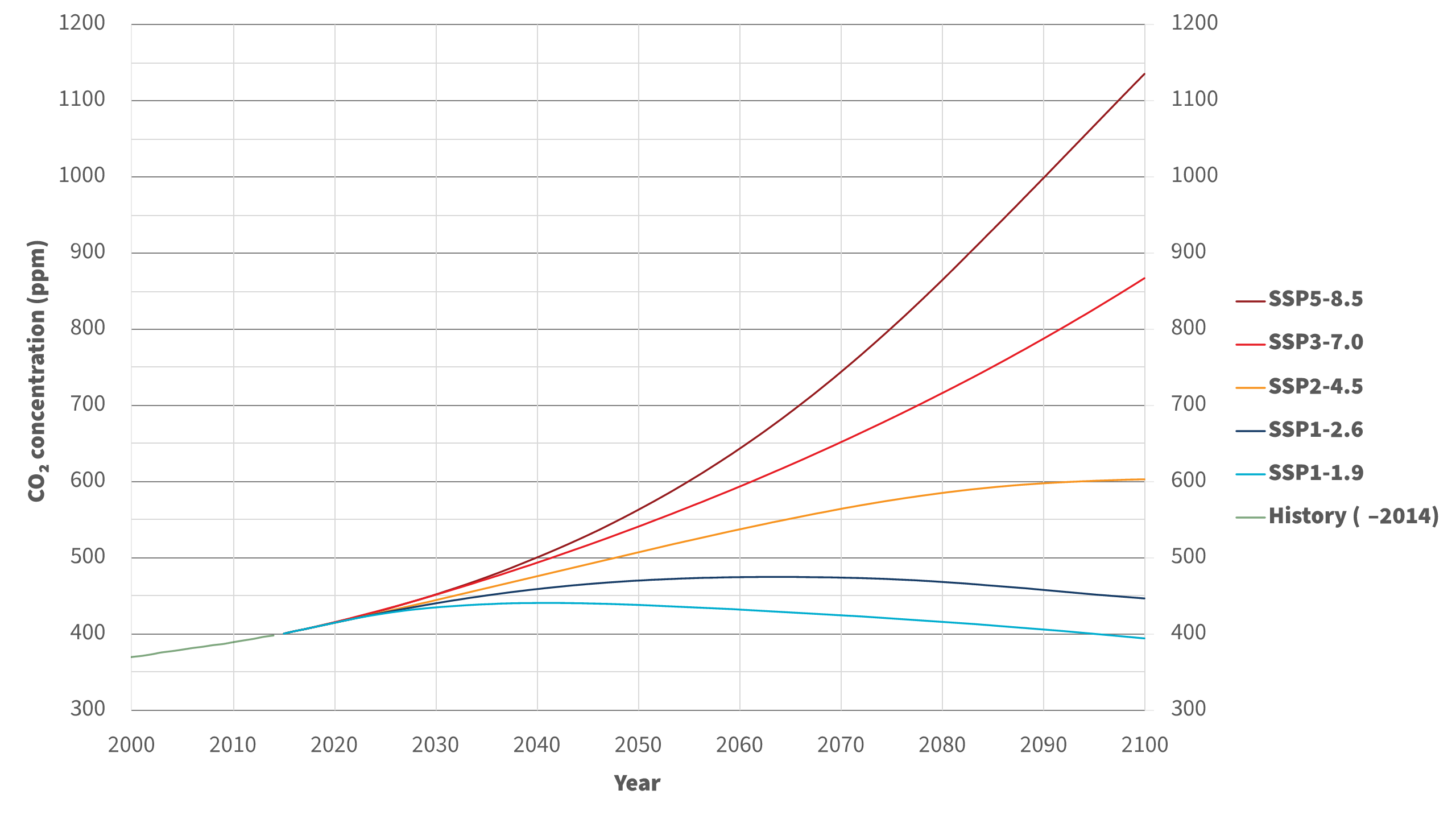
The difference between RCP and SSP is what each pathway describes. A Representative Concentration Pathway (RCP) is a pure climate outcome, a radiative-forcing trajectory such as 2.6, 4.5, 6.0 or 8.5 W/m² by 2100 (IPCC AR5). A Shared Socioeconomic Pathway (SSP) pairs that same forcing target with a socioeconomic narrative about population, economic growth, governance and technology, which is why SSPs are written as combinations like SSP1-2.6, SSP2-4.5 or SSP5-8.5, where the SSP number is the narrative and the trailing number is the RCP-equivalent forcing (IPCC AR6).
RCPs answer "how much warming?". SSPs also answer "under what societal pathway, and how plausible is it?". For corporate climate risk analysis the SSP framing is more useful because the socioeconomic narrative, not just the physical hazard, drives transition risk, regulation and market change. Regulators (CSRD/ESRS E1, ISSB/IFRS S2) and reference frameworks (NGFS) have moved to SSPs; RCPs remain valid for physical-hazard datasets where the socioeconomic layer is not needed.
In practice you rarely use pure RCPs any more. Physical hazard data (CMIP6 downscaling, EURO-CORDEX, DWD Climate Atlas) still cite RCP labels because the underlying forcing has not changed; strategic scenario portfolios speak SSPs.
How to read the label. Every AR6 scenario name has two halves separated by a dash. The digit after “SSP” points to one of the five shared socioeconomic pathways, the narrative about population, economic growth, governance and technology. The number after the dash is the radiative forcing level in watts per square metre reached in 2100, on the same forcing scale the representative concentration pathways used. Radiative forcing measures how much additional energy the atmosphere retains because of greenhouse gas emissions, relative to pre-industrial conditions, so a higher figure means more accumulated heat. SSP2-4.5 is therefore the middle-of-the-road world on a 4.5 W/m² concentration pathway, and SSP5-8.5 is the fossil-fuelled world on the 8.5 W/m² pathway that RCP 8.5 described. Because the forcing levels carry over from AR5 unchanged, the two label sets can be mapped onto each other.
| Scenario label | Socioeconomic narrative | Radiative forcing 2100 (W/m²) | Nearest RCP (AR5) | Warming by 2100, best estimate (very likely range), IPCC AR6 |
|---|---|---|---|---|
| SSP1-1.9 | SSP1 Sustainability | 1.9 | no RCP equivalent (added in AR6) | about 1.4 °C (1.0 to 1.8) |
| SSP1-2.6 | SSP1 Sustainability | 2.6 | RCP 2.6 | about 1.8 °C (1.3 to 2.4) |
| SSP2-4.5 | SSP2 Middle of the Road | 4.5 | RCP 4.5 | about 2.7 °C (2.1 to 3.5) |
| SSP4-6.0 | SSP4 Inequality | 6.0 | RCP 6.0 | not part of the AR6 headline set |
| SSP3-7.0 | SSP3 Regional Rivalry | 7.0 | no RCP equivalent (sits between RCP 6.0 and RCP 8.5) | about 3.6 °C (2.8 to 4.6) |
| SSP5-8.5 | SSP5 Fossil-fuelled Development | 8.5 | RCP 8.5 | about 4.4 °C (3.3 to 5.7) |
The mapping is a forcing equivalence, not an identity. RCP 8.5 and SSP5-8.5 land on the same forcing level, but the SSP adds assumptions about the world that produces it, and the model generation behind the numbers differs (CMIP5 for the RCPs, CMIP6 for the SSPs). Two of the AR6 pathways, SSP1-1.9 and SSP3-7.0, have no RCP counterpart at all, which is one reason a straight relabelling of old results does not work.
RCP vs SSP: Quick Decision Matrix for Your Climate Analysis
If you landed here searching for RCP scenarios or RCP vs SSP: the short answer is that SSPs (developed under CMIP6) are the modern replacement for RCPs (CMIP5). Most new corporate climate analyses should use SSPs. You still use RCPs if your financial models, insurance actuarials, or regulatory templates explicitly reference CMIP5-based RCPs, which is still common in many legacy ESG disclosure frameworks.
Live data: the Fiegenbaum Atlas provides green bond volumes, CSRD benchmarks, EU ETS prices, updated automatically. Open the dashboard.
My position. The ensemble range matters more than the median. Until mid-century, SSP scenario medians overlap substantially, so the 15th and 85th percentile carry the decision-relevant information. Single-path climate risk analyses (one RCP, one SSP) are compliance-conformant and strategically useless. If your climate risk report has one number per hazard, it underestimates the spread, and therefore the risk.
Important caveat on CMIP6 availability. SSPs based on CMIP6 are the target framework. But CMIP6 is not yet fully available as EURO-CORDEX high-resolution downscaled data. For high-resolution regional climate risk analysis in Europe, you still need to use CMIP5-based RCPs (EURO-CORDEX 12.5 km) and apply CMIP6/SSPs as a coarser-resolution delta on top. This is not a legacy workaround, it's the pragmatic best-available approach for European climate risk analysis in 2026.
| If you need… | Use | Why |
|---|---|---|
| CSRD / ESRS-aligned climate scenario analysis | SSP1-2.6 + SSP5-8.5 | ESRS E1 references IPCC AR6 which is SSP-based |
| Insurance pricing, actuarial models | RCP 2.6 + RCP 8.5 | Industry still runs CMIP5-era RCPs for legacy pricing tables |
| Internal physical risk stress testing (2030 horizon) | SSP2-4.5 | Middle-of-the-road, broad stakeholder acceptance |
| 2050+ long-horizon infrastructure | SSP5-8.5 + SSP1-2.6 | Bracket the worst and best case for capex decisions |
Read on for the detailed SSP framework, industry-specific selection guidance, and decision trees. The RCP→SSP mapping is covered in the next section.
Selecting the right Shared Socioeconomic Pathway (SSP) scenario determines whether your climate risk analysis captures material threats or produces misleading comfort. This practical guide cuts through the complexity of SSP scenarios, from ambitious sustainability pathways (SSP1-1.9) to fragmented futures (SSP3-7.0) and fossil-fueled development (SSP5-8.5), to answer one critical question: Which pathway should your business use for strategic planning in 2026?
This scenario-selection guide is part of our climate risk series. For the complete framework, see our guide to climate risk assessment and management.
The answer isn't singular, robust climate planning requires multiple scenarios. However, your industry characteristics, geographic exposure, asset longevity, strategic time horizons, and socioeconomic dependencies determine which combination delivers genuine insight versus compliance theatre. Companies with coastal facilities face fundamentally different scenario priorities than carbon-intensive manufacturers. Real estate portfolios with 50+ year horizons require different approaches than technology firms operating on 5-year planning cycles.
The SSP scenarios represent a fundamental evolution from the earlier Representative Concentration Pathways (RCP). Whilst RCPs focused exclusively on greenhouse gas concentrations and radiative forcing, SSPs integrate climate projections with socioeconomic narratives describing population growth, economic development, technological innovation, and governance structures. This integration enables more sophisticated analysis of both physical climate risks and the transition pathways needed to address them.
Current emissions trajectories have already eliminated some pathways as realistic baselines whilst making others increasingly urgent. Global temperatures have risen approximately 1.2°C above pre-industrial levels, with the 1.5°C threshold projected for the early 2030s under most scenarios. This reality constrains which futures remain plausible whilst amplifying the urgency of scenario-informed strategy.
Understanding which SSP scenarios to use, and how to integrate their socioeconomic dimensions into strategic planning, separates pragmatic risk management from paralysis-inducing over-analysis or superficial compliance exercises.
Understanding the SSP Framework: Beyond Physical Climate Outcomes
The Evolution from RCP to SSP
The Shared Socioeconomic Pathways were developed for the IPCC's Sixth Assessment Report (AR6), superseding the Representative Concentration Pathways used in the Fifth Assessment Report (AR5). This evolution reflects critical lessons learned from earlier scenario work:
What RCPs Provided:
- Four emission pathways based solely on radiative forcing targets (2.6, 4.5, 6.0, 8.5 W/m²)
- Physical climate projections (temperature, precipitation, sea level rise)
- No explicit socioeconomic context or mitigation/adaptation feasibility assessment
What SSPs Add:
- Five socioeconomic narratives describing different future worlds (SSP1-5)
- Explicit assessment of challenges to mitigation and adaptation
- Integration of demographic trends, economic development, technological change, and governance
- Clearer connection between climate policy ambition and socioeconomic preconditions
Each SSP can be combined with different climate forcing levels. For example, SSP1-2.6 combines the sustainability narrative (SSP1) with the 2.6 W/m² forcing pathway, whilst SSP5-8.5 combines fossil-fueled development (SSP5) with high emissions (8.5 W/m²). This structure enables more nuanced analysis of how different societal trajectories intersect with climate outcomes.
Why Socioeconomic Narratives Matter for Business Strategy
The socioeconomic dimensions of SSPs aren't academic abstractions, they directly affect your business through multiple channels:
Market Dynamics: Population growth and income levels determine market size and demand patterns. SSP3 describes a world with 12+ billion people but low per-capita income, whilst SSP1 projects 8-9 billion people with higher wealth. These demographic trajectories fundamentally reshape global markets.
Regulatory Environment: Governance effectiveness varies dramatically across SSPs. SSP1 assumes strong international cooperation enabling coordinated climate policy. SSP3 describes fragmented governance with weak enforcement and policy uncertainty. Your compliance costs and regulatory risks depend heavily on which governance pathway unfolds.
Technology Availability: The speed and direction of technological innovation differs substantially. SSP1 features rapid clean technology development and diffusion. SSP3 sees slow innovation with limited technology transfer. This affects both your decarbonisation options and competitive positioning.
Supply Chain Resilience: Geopolitical stability, trade openness, and infrastructure quality vary across narratives. SSP3's fragmented world with increased protectionism creates different supply chain risks than SSP1's cooperative global economy.
These socioeconomic factors often drive business risks more directly than the physical climate changes themselves, particularly over the next 10-20 years when scenario divergence in physical variables remains modest but policy and market differences become pronounced.
The Five SSP Narratives and Their Climate Pathways
The five SSPs describe distinct socioeconomic futures. Each is combined with a target radiative forcing to produce the joint scenarios corporates actually use (SSP1-1.9, SSP1-2.6, SSP2-4.5, SSP3-7.0, SSP5-8.5).
SSP1: Sustainability, "Taking the Green Road"
A world of rising international cooperation, strong governance, low population growth (peaking ~8.5 bn by 2050), rapid clean-tech innovation and shifting consumption patterns. The socioeconomic conditions that make aggressive mitigation feasible.
SSP1-1.9: 1.5 °C-aligned pathway
Warming limited to roughly 1.4-1.5 °C by 2100. Net-zero CO₂ by ~2050 with substantial negative emissions afterwards, radiative forcing peaks ~2.6 W/m² mid-century then declines to ~1.9 W/m² by 2100. Use it to test 1.5 °C alignment, Article 9 SFDR positioning, or maximum transition-risk exposure. Feasible only within SSP1's cooperative context.
SSP1-2.6: Paris-aligned baseline
Warming ~1.8 °C by 2100, forcing ~2.6 W/m². Net-zero CO₂ by ~2070; carbon prices reach €100-200/t by 2050; renewables 60-80 % of electricity by 2050. Use it as your Paris-aligned CSRD scenario, for science-based-target testing and stranded-asset planning with orderly phase-out timelines.
SSP2: Middle of the Road, "Muddling Through"
Historical trends continue. Uneven development, partial cooperation, medium population growth (~9 bn by 2100), persistent inequality, moderate technological progress, energy transition proceeds but incompletely.
SSP2-4.5: The realistic middle pathway
Warming ~2.7 °C by 2100 (range 2.1-3.5 °C), forcing ~4.5 W/m². Emissions peak 2040-2050 then decline; carbon prices ~€50-100/t by 2050; renewables 40-60 % of electricity by 2050. Use it as the central baseline (NGFS Reference frame, most regulator defaults) reflecting current policy trajectory, and as the reference case in any CSRD/ISSB disclosure.
SSP3: Regional Rivalry, "A Rocky Road"
Fragmented world with resurgent nationalism, weak international cooperation, slow technology diffusion, high population growth in vulnerable regions (~12.5 bn by 2100), rising inequality, environmental concerns deprioritised.
SSP3-7.0: Fragmentation stress
Warming ~3.6 °C by 2100, forcing ~7.0 W/m². Rising emissions with slow decarbonisation; carbon prices vary widely by jurisdiction; renewables reach only 25-40 % of electricity by 2050. Use it when global supply chains, protectionism, or emerging-market exposure dominate your risk profile, financial-services portfolios, complex manufacturing, agri-food systems. It is the scenario most companies wrongly skip.
SSP5: Fossil-Fuelled Development, "Taking the Highway"
Rapid economic growth via intensive resource use, fast tech innovation focused on productivity, high energy demand, strong global integration, adaptation resourced but insufficient at high warming.
SSP5-8.5: Physical stress bound
Warming ~4.4 °C by 2100 (range 3.3-5.7 °C), forcing ~8.5 W/m². Directly equivalent in physical forcing to the former RCP 8.5. After the 2026 CMIP7/AR7 update (van Vuuren et al., 2026) SSP5-8.5 is retired as plausible business-as-usual and used only as an upper stress bound for physical-risk testing, coastal exposure, extreme-heat planning, infrastructure resilience.
SSP4: Inequality, "A Road Divided" (rarely used commercially)
A polarised world of a wealthy globalised elite and a fragmented low-income majority. Cited in academic and equity work but rarely selected in corporate scenario portfolios because SSP3 covers similar governance-fragmentation risk with better data support.
Temperature Outcomes and Risk Profiles Across SSPs
| Scenario | 2046-2065 Warming (°C) | 2081-2100 Warming (°C) | Physical Risks | Transition Risks | Socioeconomic Context |
|---|---|---|---|---|---|
| SSP1-1.9 | 1.3 | 1.4 | Very Low | Very High | Sustainability, cooperation |
| SSP1-2.6 | 1.5 | 1.8 | Low | High | Sustainability, cooperation |
| SSP2-4.5 | 1.8 | 2.7 | Medium | Medium | Middle road, moderate challenges |
| SSP3-7.0 | 1.9 | 3.6 | High | Low-Medium | Fragmentation, conflicts |
| SSP5-8.5 | 2.4 | 4.4 | Very High | Low (until ~2040) | Fossil development, high consumption |
Critical Planning Insight: Differences between scenarios remain modest through mid-century but become fundamental by 2050-2100. For assets with 30+ year lifespans, scenario selection directly affects viability assessments and adaptation investment requirements.
Industry-Specific Scenario Selection: Matching Pathways to Exposure Profiles
Practitioner note. Official sources (DWD Climate Atlas, EEA Hazard Reports, KWRA 2021, IPCC AR6) do not provide quantitative five-tier exposure classes for the climate parameters companies need to assess. I work with thirteen parameters across eight hazard categories (heat waves, heavy precipitation, drought, storms, wildfire, flooding, frost, soil moisture), each with a five-tier threshold scale referenced to current observations, RCP 4.5 mid-century, RCP 8.5 mid-century and RCP 8.5 end-of-century. That threshold set is what turns a scenario choice into a hazard metric you can plan against. Applied end-to-end in the automotive case study; setup: Climate Risk Analysis for Companies.
Carbon-Intensive Industries
Sectors: fossil fuels, cement, steel, chemicals, aviation, shipping, heavy industry. Recommended portfolio: SSP1-2.6 + SSP2-4.5 + SSP3-7.0.
Transition risk dominates. SSP1-2.6 tests an orderly transformation (carbon price >€200/t by 2040, CCUS and hydrogen at scale); SSP2-4.5 models a fragmented transition with uneven regional carbon costs; SSP3-7.0 exposes protectionism and resource-nationalism risks that can strand assets even without extreme physical impacts. A European cement manufacturer, for example, uses SSP1-2.6 for optimal CCUS timing, SSP2-4.5 for baseline capex planning and SSP3-7.0 to size bifurcated production strategies across low-carbon and high-carbon markets.
More on this point: Voluntary vs Regulated Carbon Markets: Risks, Verification & Price Differences Explained.
Physical Asset-Intensive Industries
Sectors: real estate, infrastructure, utilities and power, agriculture, transport, logistics. Recommended portfolio: SSP2-4.5 + SSP5-8.5 (stress) + SSP3-7.0.
Long-lived assets require multi-decade physical risk testing. SSP5-8.5 identifies assets that hit fundamental viability limits (coastal properties, water-dependent facilities in arid regions); SSP3-7.0 captures the parallel risk that insurance markets and adaptation finance collapse even before physical impacts become extreme. A US REIT, for instance, may find under SSP3-7.0 that coastal insurance disappears by 2040 whilst under SSP5-8.5 the same properties still need €50 m in physical protection, forcing earlier action than either scenario alone would suggest.
Financial Services
Sectors: banking, insurance and reinsurance, asset management, pensions. Recommended portfolio: full SSP1-2.6 + SSP2-4.5 + SSP3-7.0 + SSP5-8.5 spread.
Financial institutions carry both direct and indirect (portfolio) risk, and each SSP hits a different transmission channel: SSP1-2.6 raises transition-driven defaults in carbon-intensive borrowers whilst opening green-financing opportunities; SSP3-7.0 lifts sovereign and governance risk (especially emerging markets); SSP5-8.5 drives long-horizon physical risk in real-estate and agricultural books. NGFS reference scenarios (Net Zero 2050, Delayed Transition, Current Policies, Fragmented World) map onto these SSPs and are the disclosure norm for banks and insurers.
Agriculture and Food Systems
Recommended portfolio: SSP2-4.5 + SSP3-7.0 + SSP5-8.5. Population trajectories, trade fragmentation and physical yield impacts each dominate different SSP combinations. SSP3-7.0 in particular exposes food security and supply concentration risks that pure physical-climate scenarios miss.
Technology and Services
Recommended portfolio: SSP1-2.6 + SSP2-4.5 + SSP3-7.0. Direct physical risk is limited; the material risks are indirect: supply-chain concentration, data-centre cooling and water dependency, energy-market volatility, and adaptation-market opportunities. SSP1-2.6 sizes the low-carbon services opportunity; SSP3-7.0 exposes concentration risk in critical inputs.
Time Horizon Considerations: Near-Term vs Long-Term Scenario Divergence
Short-Term Planning (2025-2030): Policy and Market Dynamics Dominate
Over the next 5 years, physical climate differences between SSP scenarios remain modest. However, policy trajectories and market dynamics diverge substantially, and these socioeconomic factors drive near-term business impacts more directly than physical climate variables.
SSP Divergence Through 2030:
- Carbon Pricing: SSP1 pathways see rapid price escalation (€80-120/tonne by 2030). SSP2 sees moderate pricing (€30-60/tonne). SSP3 sees fragmented implementation (€0-100/tonne varying by jurisdiction).
- Renewable Energy Deployment: SSP1 sees accelerated buildout supported by coordinated policy. SSP2 sees steady but uneven progress. SSP3 sees stop-start implementation with politicised reversals.
- Technology Costs: Clean technology costs decline faster in SSP1 (enabled by R&D support, manufacturing scale, international cooperation). Slower cost reductions in SSP2. Slowest in SSP3 (limited technology transfer, fragmented markets).
- Trade and Supply Chains: SSP1 maintains open trade with coordinated climate policies. SSP2 sees increasing friction from uneven standards. SSP3 sees substantial protectionism and regionalisation.
Practical Implications for Near-Term Planning:
Use SSP1-2.6 primarily to evaluate policies already enacted or highly probable (EU ETS Phase 5, US Inflation Reduction Act extensions, Carbon Border Adjustment Mechanism expansions). Physical risk analysis can use any reasonable baseline through 2030, as differences remain negligible. Focus analytical resources on understanding transition dynamics, policy evolution, market shifts, technology trajectories, rather than physical climate differentiation.
Medium-Term Planning (2030-2050): Comprehensive Scenario Divergence
By mid-century, both physical and socioeconomic dimensions diverge substantially across SSPs. This period represents the strategic sweet spot for scenario analysis, far enough that scenarios differ meaningfully, near enough that current decisions materially affect outcomes.
Physical Divergence:
- Temperature spread between SSP1-2.6 and SSP5-8.5 approaches 2°C, sufficient to fundamentally alter business conditions
- Sea level rise divergence reaches 20-30cm, the difference between manageable adaptation and facility relocation
- Extreme weather frequency and intensity show clear scenario-dependent patterns
Socioeconomic Divergence:
- Population: SSP1 peaks ~8.5 billion and declines. SSP3 approaches 12 billion. Market sizes and labour availability differ fundamentally.
- Economic Development: Per-capita income gaps between SSPs exceed 50%. Purchasing power and investment capacity vary dramatically.
- Governance: SSP1 features strong international institutions. SSP3 sees fragmented, sometimes failing states. Business operating environment differs fundamentally.
- Technology: Clean technology costs under SSP1 reach levels making fossil fuel infrastructure uneconomic even without carbon pricing. Under SSP3, technology gaps persist for decades.
Recommended Approach:
Use comprehensive multi-scenario portfolio to bound plausible outcomes. Identify "no-regret" investments delivering value across all scenarios. Develop contingent strategies triggered by observable indicators showing which pathway is unfolding. The 2030-2050 window justifies serious analytical investment, scenarios diverge enough to matter whilst remaining near enough that organisations can influence outcomes through decisions made today.
Long-Term Planning (Post-2050): Extreme Divergence and Deep Uncertainty
Beyond mid-century, scenarios diverge so dramatically that traditional planning approaches face fundamental limitations. SSP1-2.6 produces stabilised, manageable climate. SSP5-8.5 produces severe disruption. SSP3-7.0 combines moderate climate change with governance breakdown.
Planning Challenges:
- Climate system feedbacks and tipping points increase uncertainty
- Socioeconomic conditions diverge radically, from prosperous, cooperative global society (SSP1) to fragmented, conflict-ridden world (SSP3)
- Technological trajectories become increasingly speculative
- Political and governance structures may transform beyond current frameworks
Recommended Approach for Long-Term Commitments:
For organisations with truly long-term commitments (pension funds, sovereign wealth funds, nuclear facilities, major infrastructure with 75+ year lifespans), shift focus from prediction to resilience. Ask: "What conditions would make our strategy unviable?" rather than "Which scenario is most likely?"
Test against boundary scenarios, SSP5-8.5 for extreme physical impacts, SSP3-7.0 for governance breakdown, SSP1-2.6 for aggressive transition. Build adaptive capacity and strategic flexibility rather than optimising for specific outcomes. At multi-generational time scales, robustness across wide ranges of futures matters more than selecting "correct" scenarios.
Practical Decision Framework: Selecting Your SSP Portfolio
Practitioner's note: which data sources I actually use. For professional climate risk analysis I work exclusively via API with EU Copernicus and EURO-CORDEX (or CMIP6 through Copernicus), programmatic only, no web UI detours. The German Weather Service (DWD) offers a map-based interface, but from a professional portfolio-analysis perspective it's cumbersome; useful for individual cases and quick orientation. For flood data I fall back to the Überschwemmungspläne (flood maps) of the German federal states, these are necessarily map/UI-based because the high-resolution data sits in state-level databases.
How this plays out in practice: ISO 14091 Climate Risk Analysis: A Practical Guide for Companies.
Step 1: Assess Your Multi-Dimensional Risk Exposure
Question 1: What's your primary climate risk category?
- High transition risk, moderate physical risk: Carbon-intensive business model, fossil fuel dependencies → Prioritise SSP1-2.6 + SSP2-4.5
- High physical risk, moderate transition risk: Long-lived physical assets, climate-sensitive operations → Prioritise SSP2-4.5 + SSP5-8.5
- Balanced risks: Significant exposure to both physical and transition risks → Use comprehensive portfolio (SSP1-2.6, SSP2-4.5, SSP5-8.5)
Question 2: How dependent are you on specific socioeconomic conditions?
- Global supply chains: SSP3-7.0 critical for testing fragmentation and protectionism risks
- Emerging market exposure: SSP3-7.0 essential for governance and development risk assessment
- Technology-dependent decarbonisation: SSP1-2.6 vs SSP3-7.0 reveals technology access implications
- Population-sensitive demand: SSP narratives provide demographic context for market sizing
Question 3: What's your relevant time horizon?
- Primarily 2025-2030: Focus on transition scenarios and near-term policy divergence
- 2030-2050 strategic planning: Use comprehensive multi-scenario portfolio
- Post-2050 infrastructure/pensions: Include extreme scenarios for boundary-testing
Question 4: What's your geographic exposure?
- Concentrated coastal assets: SSP5-8.5 essential for sea level rise stress test
- Water-stressed regions: All high-emission scenarios plus SSP3 (governance constraints on adaptation)
- Emerging markets: SSP3-7.0 critical for governance and development pathway risks
- Multi-jurisdictional operations: SSP3 reveals regulatory fragmentation impacts
Step 2: Define Minimum Regulatory Compliance Requirements
CSRD (EU Companies): European Sustainability Reporting Standards require scenario analysis demonstrating strategy resilience. At minimum:
- One Paris-aligned scenario (≤2°C) to demonstrate transition risk assessment
- Scenarios reflecting your specific circumstances and material risks
- Explicit documentation of socioeconomic assumptions where relevant
Best practice: Use SSP1-2.6 for Paris alignment plus SSP2-4.5 baseline and either SSP3-7.0 (governance risks) or SSP5-8.5 (physical risks) depending on exposure profile.
ISSB Standards (Global): IFRS S2 Climate-related Disclosures require:
- At least one scenario aligned with limiting warming to 1.5°C above pre-industrial
- Scenarios reflecting your specific circumstances and risks
- Transparent disclosure of assumptions including socioeconomic factors
California Climate Disclosure Laws (US Companies): SB 261 requires climate-related financial risk disclosure referencing scenario analysis. Practical compliance: SSP1-2.6, SSP2-4.5, and optionally SSP5-8.5 or SSP3-7.0 depending on risk profile.
Step 3: Build Your Scenario Portfolio
Standard Recommendation for Most Companies:
Primary Portfolio:
- SSP1-2.6: Tests transition resilience under coordinated, ambitious climate policy
- SSP2-4.5: Baseline planning scenario balancing physical and transition risks with realistic socioeconomic context
- SSP5-8.5 OR SSP3-7.0: Physical risk stress test (SSP5-8.5) or governance/fragmentation stress test (SSP3-7.0), choose based on exposure profile
Alternative Portfolios by Risk Profile:
Carbon-Intensive Industries:
- SSP1-2.6 (primary): Maximum transition risk exposure with feasibility context
- SSP2-4.5: Baseline transition pathway
- SSP3-7.0: Fragmentation and policy uncertainty impacts
Physical Asset-Heavy Industries:
- SSP2-4.5 (primary): Realistic baseline for adaptation planning
- SSP5-8.5: Extreme physical risk stress test
- Optional SSP3-7.0: Governance constraints on adaptation capacity
Global Supply Chain-Dependent:
- SSP2-4.5 (primary): Baseline planning scenario
- SSP3-7.0 (critical): Fragmentation, protectionism, governance risk
- Optional SSP1-2.6: Cooperative scenario with open trade
Financial Services:
- SSP1-2.6, SSP2-4.5, SSP3-7.0, SSP5-8.5 (comprehensive): Portfolio analysis requires full spectrum
- Sector-specific emphasis: Weight scenarios based on portfolio composition
Step 4: Communicate Scenario Selection Transparently
Your disclosure should clearly articulate:
- Which specific SSP scenarios were used (e.g., "SSP1-2.6, SSP2-4.5, and SSP3-7.0 based on IPCC AR6")
- Why these scenarios were selected (e.g., "SSP1-2.6 tests transition risk under coordinated policy; SSP3-7.0 assesses fragmentation risks given our multi-jurisdictional operations and emerging market exposure")
- Time horizons assessed (e.g., "2030, 2050, and 2100 to align with asset lifecycles")
- Key assumptions including socioeconomic factors (population trends, governance effectiveness, technology availability, trade openness)
- How scenarios informed strategy (specific decisions or investments resulting from analysis)
Socioeconomic Narrative Communication:
When using SSPs, explicitly reference the socioeconomic dimensions where they affect your analysis:
"Under SSP3-7.0, we assessed combined risks from moderate physical climate impacts (3.6°C warming) and governance fragmentation. The scenario assumes weak international cooperation, reduced technology transfer, and protectionist trade policies. For our operations across 15 countries, these socioeconomic factors create supply chain risks and regulatory complexity that compound physical climate impacts. This scenario drove our decision to regionalise production capacity and increase inventory buffers."
This level of specificity demonstrates genuine analytical rigour whilst helping stakeholders understand how socioeconomic context shapes your risk assessment.
TCFD, NGFS, and IFRS S2: Where RCP/SSP Scenarios Fit in Disclosure
Climate scenarios drive several converging disclosure frameworks. The choice between RCP and SSP affects how your physical risk numbers, transition risk numbers, and scenario narratives map onto required disclosures.
TCFD Scenario Analysis
The Task Force on Climate-related Financial Disclosures (TCFD) framework requires climate scenario analysis as part of the strategy pillar. It does not prescribe RCP versus SSP specifically. The 2017 recommendations reference RCPs (CMIP5 era); the 2021 implementation guidance acknowledges SSPs as the modern equivalent. A typical TCFD scenario set pairs a 2°C-or-below pathway (RCP 2.6 or SSP1-2.6) with a high-warming reference (RCP 8.5 or SSP5-8.5), and documents which CMIP cycle the underlying climate data uses.
IFRS S2 / ISSB Climate Disclosures
IFRS S2 is the ISSB climate disclosure standard, effective for annual reporting periods beginning on or after January 1, 2024. It builds directly on TCFD and inherits its scenario language. IFRS S2 requires entities to explain how their scenario analysis is consistent with the latest international agreement on climate change, which in practice means IPCC-aligned RCP or SSP scenarios rather than vendor-proprietary pathways. The standard also requires disclosure of the scenario assumptions, time horizons, and the climate-related risks and opportunities considered.
NGFS Scenarios for Financial Risk Stress Testing
The Network for Greening the Financial System (NGFS) publishes scenario sets designed for financial sector stress testing. The current Phase 5 release (2024) includes Net Zero 2050, Below 2°C, Delayed Transition, Fragmented World, and Current Policies. NGFS scenarios are built on top of Integrated Assessment Models that consume SSP inputs and produce harmonized transition-risk variables: carbon prices, technology cost curves, energy mix evolution, sectoral output. For a corporate scenario analysis, NGFS scenarios complement rather than replace RCP/SSP: the physical climate signal still comes from CMIP6 (SSP-driven) or CMIP5 (RCP-driven) projections, and NGFS adds the harmonized economic-transition layer on top.
CSRD / ESRS E1 Scenario Requirements
ESRS E1 (the European Sustainability Reporting Standard on climate change) requires at least one scenario "aligned with limiting climate change to 1.5°C in line with the Paris Agreement" plus comparison with a higher-warming pathway. In practice this is SSP1-2.6 or RCP 2.6 for the Paris-aligned case, and SSP3-7.0 or SSP5-8.5 for the stress case. ESRS E1 explicitly lists the physical risk categories that scenarios must inform: acute physical risks (extreme heat days, heavy precipitation, river flooding, coastal flood, wildfire) and chronic physical risks (mean temperature shift, drought indices, sea-level rise, water stress). On the transition side, the scenarios must inform policy, legal, technology, market, and reputation risks.
Physical Hazard Metrics Across Frameworks
All four frameworks (TCFD, IFRS S2, NGFS, CSRD) converge on a small set of hazard metrics that are computed from RCP or SSP climate projections after downscaling. The downscaling step matters: statistical downscaling (bias-correcting global model output against observed stations) and dynamical downscaling (running a regional climate model nested inside the global model) produce different uncertainty envelopes, and high-resolution European data is currently CMIP5-only (EURO-CORDEX 12.5 km) until CMIP6 EURO-CORDEX completes.
Bottom line: the disclosure frameworks converge on IPCC scenario families. The RCP versus SSP choice is increasingly about your downscaled data availability and your regulator's template references, not about which framework prefers which scenario set.
Common Pitfalls and How to Avoid Them
Pitfall 1: Using SSPs Purely as Climate Scenarios
The Problem: Companies use SSP1-2.6, SSP2-4.5, and SSP5-8.5 but ignore the socioeconomic narratives, treating them simply as updated RCPs.
Why It's Wrong: This approach misses the primary value addition of SSPs. The socioeconomic dimensions, population trends, governance effectiveness, technology development, trade patterns, often drive business risks more directly than physical climate variables, particularly over 10-30 year horizons.
Correction: Explicitly incorporate socioeconomic assumptions into your analysis. When evaluating SSP3-7.0, assess both the 3.6°C warming AND the implications of fragmented governance, high population growth, limited technology transfer, and protectionist trade. Document how these socioeconomic factors affect your risk assessment and strategic response.
Pitfall 2: Ignoring SSP3-7.0 as "Middle Ground"
The Problem: Companies default to SSP1-2.6, SSP2-4.5, and SSP5-8.5, viewing SSP3-7.0 as unnecessary "middle ground" between SSP2 and SSP5.
Why It's Wrong: SSP3-7.0 doesn't represent a middle ground, it represents a fundamentally different risk profile. The combination of moderate physical impacts with governance breakdown, fragmented markets, and limited adaptation capacity creates unique strategic challenges often more severe than higher-emission scenarios with stronger institutions.
Correction: For companies with global supply chains, emerging market exposure, or dependency on international cooperation, SSP3-7.0 often proves more strategically relevant than SSP5-8.5. Evaluate whether governance and socioeconomic risks dominate your exposure profile. If so, prioritise SSP3-7.0 in your scenario portfolio.
Pitfall 3: Treating SSP5-8.5 as "Business-as-Usual"
The Problem: Despite the evolution to SSPs, companies still default to SSP5-8.5 as baseline "no action" scenario.
Why It's Wrong: SSP5-8.5 describes not just high emissions but a specific socioeconomic pathway, rapid economic growth, fossil fuel dependence, high consumption. Current trends don't align with this narrative. Renewable energy economics, policy momentum, and demographic trends more closely resemble SSP2-4.5.
Correction: Use SSP5-8.5 explicitly as extreme physical risk stress test, not baseline planning scenario. For "realistic baseline," use SSP2-4.5. Communicate SSP5-8.5 as "high-impact, decreasing-probability" boundary testing rather than "business-as-usual."
Pitfall 4: Using Only One Scenario
The Problem: Single-scenario analysis creates false precision, suggesting predictability where genuine uncertainty exists.
Why It's Wrong: Both climate and socioeconomic futures remain deeply uncertain over multi-decade horizons. Population growth, governance evolution, technology trajectories, and international cooperation could follow multiple plausible pathways. Single-scenario planning produces strategies optimised for one future whilst potentially fragile to others.
Correction: Always use at least two scenarios, preferably three. Common combinations: (1) SSP1-2.6 + SSP2-4.5 + SSP5-8.5 for broad coverage, (2) SSP1-2.6 + SSP2-4.5 + SSP3-7.0 for transition-focused companies with governance exposure, or (3) SSP2-4.5 + SSP3-7.0 + SSP5-8.5 for physical-risk-focused companies.
Pitfall 5: Disconnecting Scenarios from Strategy
The Problem: Scenario analysis produces comprehensive reports without informing actual decisions. Analysis becomes compliance exercise rather than strategic input.
Why It's Wrong: SSP scenario analysis requires substantial investment in data, modelling, and management time. If it doesn't influence capital allocation, facility siting, supplier selection, technology roadmaps, or market strategy, it creates process burden without value.
Correction: Explicitly document strategic decisions informed by scenarios. Examples:
- "SSP3-7.0 analysis revealed supply chain fragmentation risk. We established dual-sourcing arrangements for critical components, accepting 8% cost increase for resilience."
- "SSP1-2.6 transition pathway modelling showed carbon pricing reaching €150/tonne by 2035. We accelerated electrification capex by €50M to avoid higher future costs."
- "SSP5-8.5 coastal flood modelling indicated our Miami facility faces €30M adaptation costs or relocation. We initiated site evaluation for alternative locations."
Range Over Single Path: What Actually Decides the Analysis
Asking which scenario is the right one leads nowhere. A climate risk assessment that runs a single pathway is formally compliant and strategically worthless. It produces a number where the decision needs a range.
The reason sits in the data. Until mid-century the scenarios overlap considerably in their median values and only diverge clearly after that. Reporting the median of one pathway therefore shows almost no difference across the planning-relevant period while understating the spread. What matters is the 15th and 85th percentile of the ensemble range.
For long-lived assets this shifts further: the median is the wrong measure, and the 85th percentile of a high emissions scenario is the relevant figure. That is what RCP 8.5 is useful for. Not as a likely trajectory, but as the upper bound you test your design against.
A worked parameter shows the size of the gap. For days above 30 degrees in northern Germany, the historical normal range is zero to five per year. Mid-term under RCP 4.5 expect six to ten, by mid-century under RCP 8.5 eleven to twenty, and towards the end of the century more than thirty-five. Reporting any one of those figures instead of the range understates the risk systematically, regardless of which figure is chosen.
In practice: run at least two pathways, report a range per metric rather than a point value, and document which percentile informs which decision. It is more work than the single-path version, and it is the difference between a document for the file and a basis on which someone approves an investment.
Frequently Asked Questions
1. Should I use RCP or SSP scenarios for business planning in 2026?
Use SSP scenarios. They represent the current scientific standard (IPCC AR6) and provide richer strategic context through integrated socioeconomic narratives. SSP1-2.6, SSP2-4.5, and SSP5-8.5 offer the same physical climate projections as their RCP counterparts (2.6, 4.5, 8.5 W/m² forcing) whilst adding critical information about population trends, governance effectiveness, technology development, and market evolution. These socioeconomic factors directly affect business strategy in ways that pure climate projections cannot capture.
RCPs remain acceptable if data availability or analytical capacity limits your scope, but SSPs represent best practice for comprehensive climate risk assessment in 2026.
2. Do I need to analyze all five SSP narratives?
No. Most companies benefit from analysing 2-3 SSP scenarios selected based on risk profile. Common portfolios:
- Standard Portfolio: SSP1-2.6 (transition test) + SSP2-4.5 (baseline) + SSP5-8.5 or SSP3-7.0 (stress test)
- Carbon-Intensive Focus: SSP1-2.6 + SSP2-4.5 + SSP3-7.0 (emphasising transition and governance)
- Physical Asset Focus: SSP2-4.5 + SSP5-8.5 (emphasising physical risks)
- Global Supply Chain Focus: SSP2-4.5 + SSP3-7.0 (emphasising fragmentation risks)
SSP1-1.9 typically remains optional except for companies pursuing 1.5°C alignment or Article 9 sustainable finance classification. Justify scenario exclusions based on materiality assessment rather than attempting comprehensive coverage.
3. How do I communicate the socioeconomic dimensions of SSPs to stakeholders?
Focus on business-relevant implications rather than academic descriptions. Examples:
Poor communication: "We used SSP3-7.0, which assumes high challenges to mitigation and adaptation."
Better communication: "We assessed SSP3-7.0, a scenario combining moderate climate change (3.6°C warming) with fragmented international cooperation, protectionist trade policies, and limited technology transfer. For our multi-jurisdictional operations and global supply chains, this scenario creates compounding risks: physical climate impacts in vulnerable production regions, regulatory fragmentation increasing compliance costs, and trade barriers disrupting logistics networks."
Connect socioeconomic assumptions to specific business implications. This demonstrates analytical rigour whilst helping stakeholders understand how narratives shape your risk assessment.
4. What if stakeholders or regulators still reference RCPs?
Many stakeholders remain more familiar with RCP terminology. Bridge the communication gap by referencing both frameworks where helpful:
"We conducted scenario analysis using SSP1-2.6, SSP2-4.5, and SSP5-8.5 from the IPCC's Sixth Assessment Report. These scenarios provide the same physical climate projections as the previously used RCP 2.6, 4.5, and 8.5 pathways, whilst incorporating socioeconomic narratives that inform our assessment of transition feasibility and adaptation capacity."
This approach acknowledges familiarity with RCPs whilst explaining the added value of SSP framework.
5. How often should I update my SSP scenario analysis?
Formal updates should occur every 2-3 years or when material changes occur:
- Significant shifts in business operations, geographic exposure, or strategic priorities
- Major climate policy developments (carbon pricing expansions, new international agreements)
- New IPCC assessment reports with updated projections
- Observed climate or socioeconomic trends deviating substantially from previous assumptions
Between formal updates, monitor key indicators:
- Climate indicators: Global temperature anomalies, emissions trajectories, extreme weather frequencies
- Transition indicators: Carbon prices, renewable energy deployment, EV adoption, policy stringency
- Socioeconomic indicators: Population trends, geopolitical stability, technology costs, trade patterns
If indicators suggest substantial divergence from your baseline assumptions, conduct interim qualitative review to determine whether earlier formal refresh is warranted.
6. Can I use simplified SSP analysis if resources are constrained?
Yes. Better to conduct focused SSP analysis than abandon scenario planning due to resource constraints. Simplified approach:
- Identify 2-3 critical climate dependencies (e.g., coastal facility exposure, key supplier locations, water availability)
- Select 2 SSP scenarios bounding plausible range (typically SSP2-4.5 + either SSP3-7.0 or SSP5-8.5)
- Evaluate those dependencies under selected scenarios using publicly available climate data and qualitative socioeconomic assessment
- Document explicitly what you analyzed and what you excluded, with justification based on materiality
- Commit to expanding scope as resources permit
Focused, transparent analysis proves more valuable than attempting comprehensive coverage without adequate resources. Many companies successfully begin with simplified approaches, then expand scope over 2-3 year improvement cycles.
7. What is the difference between RCP and SSP scenarios?
In short: an RCP describes only the climate outcome, a radiative-forcing pathway such as 2.6, 4.5 or 8.5 W/m² by 2100. An SSP pairs that same forcing level with a socioeconomic story about population, economic growth, governance and technology, which is why SSPs are written as a combination such as SSP2-4.5, where SSP2 is the narrative and 4.5 is the forcing. RCPs (IPCC AR5) answer “how much warming?”; SSPs (IPCC AR6) also answer “under which societal pathway, and how plausible is it?”. For business strategy the SSP framing is more useful because the socioeconomic narrative, not just the physical hazard, drives transition risk, regulation and market change.
8. Is SSP2-4.5 the “business as usual” or “middle of the road” scenario?
SSP2-4.5 is the “middle of the road” scenario and is widely used as the central or baseline case, with roughly 2.7°C of warming by 2100. It is the closest thing to a realistic current trajectory given today’s policies, which is why many companies anchor their analysis to it. The “business as usual” label historically referred to RCP 8.5 / SSP5-8.5, but that high-end pathway is now considered implausible as a baseline (see the 2026 update below) and should be used only as an upper stress bound, not as your expected case.
9. What do SSP1-2.6, SSP2-4.5 and SSP5-8.5 mean?
These are the three scenarios most companies actually use:
- SSP1-2.6 (Sustainability, the green road): strong climate action, roughly 1.8°C by 2100. Your transition test.
- SSP2-4.5 (Middle of the Road): moderate action, roughly 2.7°C. Your central baseline.
- SSP5-8.5 (Fossil-fuelled Development): roughly 4.4°C. An upper stress bound, no longer treated as business as usual.
SSP3-7.0 (Regional Rivalry, roughly 3.6°C) is the relevant high-end scenario when fragmentation and supply-chain risk matter more than raw emissions.
10. Is SSP5-8.5 (RCP 8.5) still used after the 2026 IPCC scenario update?
Only as a worst-case stress test, not as a likely future. In 2026 the climate-science community published a new scenario set for CMIP7 and the upcoming seventh IPCC Assessment Report (van Vuuren et al., 2026) that retires the highest pathways, RCP 8.5, SSP5-8.5 and SSP3-7.0, as implausible business as usual, because falling renewables costs, real climate policy and observed emission trends have overtaken them. Seven new pathways named by emission level take their place. For corporate climate risk analysis you can still run SSP5-8.5 as an upper sensitivity bound, but your central planning case should sit around SSP2-4.5.
11. Is RCP 8.5 the same as SSP5-8.5?
In terms of radiative forcing they line up: both reach about 8.5 W/m² by 2100, so SSP5-8.5 is the direct successor to RCP 8.5 and the two are often used interchangeably for the high-end physical climate signal. The difference is the story behind the number. RCP 8.5 is a pure concentration pathway, while SSP5-8.5 adds a socioeconomic narrative of fossil-fuelled, energy-intensive growth that produces that forcing. So for hazard data and physical risk they are effectively equivalent, but SSP5-8.5 also carries assumptions about the world that drives it. Note that both are now treated as a very high-end stress case rather than a likely future, not a central planning scenario.
12. What does SSP2-4.5 stand for, and what temperature outcome does it project?
SSP2-4.5 combines the SSP2 socioeconomic narrative ("middle of the road", broadly a continuation of historical trends in population growth, technology, and cooperation) with a radiative forcing of 4.5 W/m² in 2100 (the same physical target as the former RCP 4.5). It projects a likely global mean warming of roughly 2.1 to 3.5 °C above pre-industrial by 2100, with a best estimate around 2.7 °C. Under CMIP6 and IPCC AR6, SSP2-4.5 is the central reference scenario used by most regulators and by NGFS reference frameworks: neither aggressive mitigation nor high-end emissions, closer to a plausible baseline given current policies. For most companies it is the natural planning case, paired with SSP5-8.5 as an upper stress bound.
13. Why don't SSP-based IPCC scenarios include specific climate policy assumptions?
SSP-based IPCC scenarios intentionally do not include prescribed climate policies inside the baseline SSPs themselves. The reason is methodological: the five SSP narratives describe reference futures defined by socioeconomic drivers (population, GDP, technology, inequality, governance) without new climate policy, so they set a policy-neutral backdrop. Climate policy is added on top as a separate layer through the "SPA" (Shared Policy Assumptions) framework, combined with the target radiative forcing to produce the joint SSP-RCP scenarios such as SSP1-2.6 or SSP2-4.5. This separation lets researchers and regulators cleanly vary either dimension: hold the socioeconomic world constant and change the mitigation ambition, or hold the temperature target constant and vary the socioeconomic pathway. For businesses this matters because the same forcing level (say 4.5 W/m²) can be reached from very different worlds, and the risk profile changes with the narrative.
Key Takeaways
- Use SSPs, not standalone RCPs. SSPs pair the same physical forcing (2.6, 4.5, 7.0, 8.5 W/m²) with a socioeconomic narrative that drives transition, regulation and market risk.
- Anchor to SSP2-4.5. The "middle of the road" pathway (~2.7 °C by 2100) is the central reference used by CSRD, ISSB and NGFS baseline frameworks.
- Run 2 to 3 scenarios, not five. A workable portfolio is SSP1-2.6 (transition test) + SSP2-4.5 (baseline) + either SSP3-7.0 (fragmentation stress) or SSP5-8.5 (physical stress). Justify exclusions via materiality.
- Do not skip SSP3-7.0. Fragmentation, supply-chain and governance risk often exceed the impact of pure high-emission pathways for globally exposed firms.
- Treat SSP5-8.5 (and RCP 8.5) as stress bound, not baseline. After the 2026 CMIP7/AR7 update they are no longer plausible business-as-usual.
- Balance the time horizon. Near-term (to 2030): transition and policy divergence dominate. Long-term (2050+): physical climate divergence dominates.
- Document what you used and why. Which SSPs, which socioeconomic assumptions, which strategic decisions followed. Auditors and regulators grade the reasoning, not the choice.
- Iterate. First analyses are rough. Establish a baseline, then refine methods and scope on a 2 to 3 year cycle.
Selecting appropriate SSP scenarios is the foundation of a credible climate risk analysis, not the deliverable. If you want the methodology applied end-to-end with EURO-CORDEX data, quantified capex implications and CSRD-compliant documentation, see Climate Risk Analysis for Companies or contact us.

Johannes Fiegenbaum
ESG and sustainability consultant based in Hamburg, specialised in VSME reporting and climate risk analysis. Has supported 300+ projects for companies and financial institutions, from mid-sized manufacturers to major banks and insurers.
More aboutYou may also like
CORDEX EUR-11 vs. CMIP6: Climate Data Choice for Risk Analysis
When companies report their physical climate risks under CSRD, the EU Taxonomy or IFRS S2, the methodological choice comes down to a data question: which climate projections carry ...
Read more →