
58 min read
When Is the VSME Comprehensive Module Worth It?
The Comprehensive Module adds 47 data points, but it is a different type of work. While the Basic Module mostly asks for numbers, the Comprehensive Module requires strategic narratives: business model description, climate strategy, human rights policies. These are texts that many SMEs have not yet formalised.
A pragmatic approach: use the Comprehensive Module as an internal strategy exercise. The questions EFRAG asks, “How does your business model contribute to sustainability?”, “What climate risks do you see?”, are precisely the questions that board members and investors should be answering anyway. The VSME gives you a structure for that conversation.
General, 7 data points
C01.000 Strategy: Business Model and Sustainability, Related Initiatives 4 data points
| Data Point | Format |
|---|---|
| Description of significant groups of products and/or services offered | narrative |
| Description of significant market(s) the undertaking operates in | narrative |
| Description of main business relationships (e.g. key suppliers, customers distribution chann... | narrative |
| Description of key elements of strategy that relates to or affects sustainability issues | narrative |
C02.000 Description of practices, policies and/or future initiatives for transitioning towards a more sustainable economy 3 data points
| Data Point | Format |
|---|---|
| Description of practices, policies and/or future initiatives | narrative |
| Most senior level within its employees that is accountable for policies | narrative |
| Description of the target of practices, policies or future initiatives | narrative |
Environment, 18 data points
C03.000 Greenhouse Gas Emissions Reduction Baseline and Target Year 2 data points
| Data Point | Format |
|---|---|
| Greenhouse gas emission reduction target base year | year |
| Greenhouse gas emission reduction target year | year |
C03.100 Greenhouse Gas Emission Reduction Targets 8 data points
| Data Point | Format |
|---|---|
| Gross Scope 1 greenhouse gas emissions | tCO₂e |
| Gross location-based Scope 2 greenhouse gas emissions | tCO₂e |
| Gross market-based Scope 2 greenhouse gas emissions | tCO₂e |
| Total (gross) location-based Scope 1 and Scope 2 GHG emissions | tCO₂e |
| Total (gross) market-based Scope 1 and Scope 2 GHG emissions | tCO₂e |
| Gross Scope 3 greenhouse gas emissions | tCO₂e |
| Total (gross) location-based GHG emissions | tCO₂e |
| Total (gross) market-based GHG emissions | tCO₂e |
C03.200 Disclosure of list of main actions the entity seeks to achieve its targets 1 data points
| Data Point | Format |
|---|---|
| Disclosure of list of main actions the entity seeks in order to achieve its targets | narrative |
C03.300 Transition plan for undertakings operating in high climate impact sectors 2 data points
| Data Point | Format |
|---|---|
| Description of a transition plan for climate change mitigation, including an explanation of ... | narrative |
| Date of adoption of transition plan for undertaking not having adopted transition plan yet | date |
C04.000 Climate risks 5 data points
| Data Point | Format |
|---|---|
| Description of climate-related hazards and climate-related transition events | narrative |
| Disclosure of how it has assessed the exposure and sensitivity of its assets, activities and... | narrative |
| Time horizons of any climate-related hazards and transition events identified | narrative |
| Disclosure of whether it has undertaken climate change adaptation actions for any climate re... | Yes / No |
| Potential adverse effects of climate risks that may affect its financial performance or busi... | narrative |
Social, 13 data points
C05.000 Additional (general) workforce characteristics 3 data points
| Data Point | Format |
|---|---|
| Female-to-male ratio at management level for the reporting period | number |
| Total number of self-employed workers without personnel that are working exclusively for the... | number |
| Total number of temporary-workers provided by undertakings primarily engaged in employment a... | number |
C06.000 Additional own workforce information - Human rights policies and processes 4 data points
| Data Point | Format |
|---|---|
| Undertaking has a code of conduct or human rights policy for its own workforce | Yes / No |
| Type of content covered by the code of conduct or human rights policy for its own workforce | multi-select |
| Specification other types of content covered by the code of conduct or human rights policy | text |
| Undertaking has a complaint handling mechanism for its own workforce | Yes / No |
C07.000 Severe negative human rights incidents 6 data points
| Data Point | Format |
|---|---|
| Undertaking has confirmed human rights incidents in its own workforce | Yes / No |
| Type of human right related to the confirmed incident | multi-select |
| Specification of other human rights related to the confirmed incident | narrative |
| Description of actions take to address the confirmed incidents | narrative |
| Undertaking aware of any confirmed incidents involving workers in the value chain, affected ... | Yes / No |
| Specification of any confirmed incident involving workers in the value chain, affected commu... | narrative |
Governance, 9 data points
C08.000 Revenues derived from activities 7 data points
| Data Point | Format |
|---|---|
| Revenue derived from controversial weapons (anti-personnel mines, cluster munitions, chemica... | € |
| Revenue derived from cultivation and production of tobacco | € |
| Total revenues derived from fossil (fuel, coal and gas) sector | € |
| Revenue derived from coal | € |
| Revenue derived from oil | € |
| Revenue derived from gas | € |
| Revenue derived from chemical production | € |
C08.100 Exclusion from EU benchmarks 1 data points
| Data Point | Format |
|---|---|
| Undertakings are excluded from any EU reference benchmarks that are aligned with the Paris A... | Yes / No |
C09.000 Gender diversity ratio in the governance body 1 data points
| Data Point | Format |
|---|---|
| Gender diversity ratio in governance body | number |
All 147 data points, guided, not alone.
VSEasy walks you through every field with pre-filled suggestions, automatic GHG calculations, and built-in validation.
Try VSEasy Free →How Does the EFRAG Digital Template and XBRL Taxonomy Fit In?
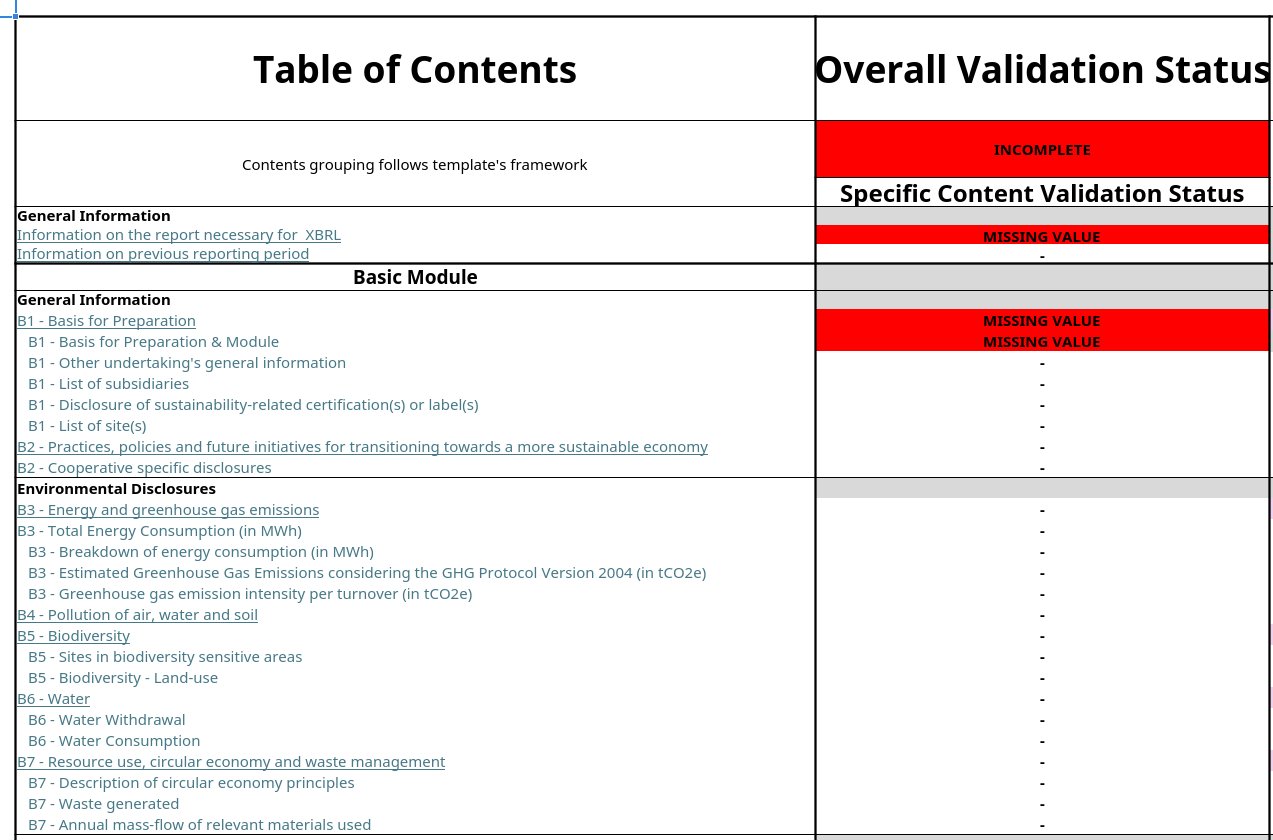
When people search for a VSME template, they rarely mean the standard document. They mean EFRAG's own file: the VSME Digital Template, a free Excel workbook that turns the 147 data points into fields you can fill in. Start there rather than in your own spreadsheet: validation, conversion and the data requests your customers send are all built around that file.
Two more pieces sit around it. The VSME XBRL taxonomy defines the machine-readable tag behind every data point, and the XBRL converter on EFRAG's GitHub turns a filled workbook into a tagged file. The converter is optional if you hand your bank a PDF, and necessary once a CSRD-obligated customer pulls value chain data automatically.
The workbook keeps the standard's own numbering, so every code in the inventory above has its place in it:
| Block in the Digital Template | Data point codes | Points | What you fill in there |
|---|---|---|---|
| Basic, General | B01.000 to B02.100 | 29 | Basis for preparation, subsidiaries, sites, transition practices |
| Basic, Environment | B03.000 to B07.400 | 51 | Energy, GHG emissions and intensity, pollution, biodiversity, water, waste |
| Basic, Social | B08.000 to B10.000 | 18 | Workforce by contract, gender and country, turnover, health and safety, pay |
| Basic, Governance | B11.000 | 2 | Convictions and fines for corruption and bribery |
| Comprehensive, General | C01.000 to C02.000 | 7 | Business model, sustainability strategy, policy accountability |
| Comprehensive, Environment | C03.000 to C04.000 | 18 | Reduction baseline and targets, transition plan, climate risk |
| Comprehensive, Social | C05.000 to C07.000 | 13 | Additional workforce data, human rights policies and incidents |
| Comprehensive, Governance | C08.000 to C09.000 | 9 | Revenues from controversial activities, benchmark exclusion, gender ratio |
The workbook comes in 11 EU language versions with identical codes, which makes a report filled in Portuguese comparable to one in Finnish. EFRAG has announced a data migration tool for the fourth quarter of 2026 that will carry entries from an older workbook version into a newer one; until then, moving to a new template version is manual work.
One habit before you convert: leave the structure of the workbook alone. Inserting rows, renaming sheets or merging cells breaks conversions that would otherwise have worked, and the error points at the taxonomy, not at the row you moved.
How Do You Start Your First VSME Report?
1. Assign responsibilities before collecting data
The most common mistake: someone gets “sustainability” dropped on their desk and tries to fill every field alone. That does not work. VSME data comes from at least four departments:
- Management / Finance: Revenue, assets, legal form, NACE codes (B01)
- Operations / Facilities: Energy, emissions, waste, water (B03, B07)
- HR: Headcount, work-related accidents, remuneration (B08, B10)
- Compliance: Anti-corruption, human rights processes (B11, C06, C07)
A short kick-off meeting with clear ownership, “who delivers what by when?”, saves weeks.
2. Start with data you already have
Many data points already exist, just not in a sustainability report. Electricity bills, heating invoices, waste disposal records, HR master data: that is the core of B03 through B10. Collect what is already available before planning new data collection.
3. Prioritise gaps
It is better to submit a report with a documented gap than no report at all. The VSME explicitly allows this: in B01.000 you list which disclosures you have omitted and why. Typical first-year gaps: Scope 3 emissions and detailed biodiversity data.
4. Use the EFRAG Excel or a dedicated tool
EFRAG provides a free Excel template (version 1.2.0, available in 11 EU languages) with built-in validation. For SMEs that prefer a guided experience, VSEasy offers automatic calculations and step-by-step workflows.
What Are the Most Common VSME Reporting Mistakes?
- Mixing up Scope 2 methods: The VSME asks for both location-based and market-based Scope 2 emissions. Location-based uses your country's grid average factor; market-based uses the factor from your actual energy contract. Both must be reported separately.
- Forgetting GHG intensity: B03.300 requires emissions per euro of revenue. Make sure you use the same revenue figure from B01.000.
- Mixing waste units: Sections B07.100 and B07.200 accept mass (tonnes) and volume (m³). Pick one and stay consistent, otherwise you will trigger validation errors.
- Ignoring Scope 3: Even the Basic Module asks for Scope 3 emissions. If you cannot calculate precisely, provide an estimate and document your methodology. An honest estimate is better than a gap.
- Working alone: VSME is a cross-functional topic. Treating it as a solo task leads to incomplete data or abandoned reports.
How Does the VSME Become a Competitive Advantage?
Most SMEs see the VSME as a chore. That is understandable, but it leaves value on the table. Three perspectives worth considering:
Better conversations with banks: Sustainability data is increasingly part of credit risk assessment. A VSME-compliant report shows your bank that you understand and manage your risks, which can directly improve your financing terms.
Stronger supplier positioning: Large companies under CSRD prefer suppliers who can deliver structured ESG data. Proactive VSME reporting makes you the preferred partner, rather than a gap in your customer's value chain report.
Better operational management: The data you collect for the VSME, energy consumption, waste ratios, employee turnover, are also operational management KPIs. Knowing your energy consumption means you can optimise it. Measuring turnover means you can act on it.
Frequently Asked Questions
Is the VSME mandatory?
No. The VSME is voluntary. However, the data it covers is increasingly requested by business partners and banks. A structured VSME report saves significant time compared to answering ad-hoc ESG questionnaires.
How long does the first report take?
Data collection typically takes 2 to 4 weeks, spread across departments. The actual report filling with a guided tool like VSEasy takes 2 to 4 hours. Year two is significantly faster because data sources and processes are already in place.
What is the difference between VSME and ESRS?
The ESRS apply to large listed companies and contain 1,100+ data points. The VSME is the simplified version for SMEs with 147 data points. Both standards are compatible, your VSME data flows directly into your customers' CSRD value chain reports.
Do I need to fill every data point?
No. The VSME allows justified omissions, list them in section B01.000. However, aim for maximum completeness: every gap reduces the report's value for your stakeholders.
Do I need the Comprehensive Module?
Not in the first year for most SMEs. Start with the Basic Module. Add the Comprehensive Module when your bank or largest customer specifically asks for climate strategy or human rights due diligence.
What format does the report need?
No format is mandated. EFRAG provides a free Excel template that can optionally be converted to machine-readable XBRL.
Is the VSME available in my language?
The official EFRAG template is available in 11 EU languages including English, German, French, Spanish, Italian, Dutch, and more.
How are GHG emissions reported?
The Basic Module requires Scope 1 (direct), Scope 2 (purchased energy, both location-based and market-based), and Scope 3 (value chain) in tCO₂e, plus intensity ratios per euro of revenue.
Where do I download the official EFRAG VSME Digital Template, and is it free?
From EFRAG itself. The workbook is published free of charge alongside the standard and sits with the converter in EFRAG's public repository. A VSME template you pay for is someone else's formatting of it.
Is the template available in my language, and why is it only partly translated?
It is published in 11 EU language versions. Translated are the field labels, not your content, and a language version can trail the English master after a taxonomy update. The codes are identical everywhere, so check the English workbook if a label looks off.
Do I have to fill every cell for the XBRL conversion to succeed?
No. The VSME allows justified omissions and you list them in B01.000. Conversion only cares that the cells you did fill match the format the taxonomy expects. An empty field is a gap in your report, a wrongly typed one is a failed conversion.
Can I unlock or modify the structure of the workbook, and what breaks if I do?
You can, and it is the most reliable way to break the conversion. Inserting rows, renaming sheets or merging cells detaches fields from their taxonomy tags, and the error rarely names the change that caused it.
Can one template cover more than one reporting year?
Plan on one workbook per reporting year. Comparability comes from filling the same codes again next year, not from stacking years into one file.
What is the XBRL converter for, and who needs the machine-readable output?
It produces the tagged version of your report, the one software reads without a human retyping it. You need it when a customer or bank ingests value chain data automatically, not for a first report that goes to two customers by email.
Measured across more than 1,000 public 2024 and 2025 reports from European listed companies: 67 percent contain complete Scope 1, 2 and 3 data. 14 percent publish no extractable Scope data at all. And in 8 percent of the reports that do carry a Scope 3 figure, Scope 3 comes out smaller than Scope 1 or 2, which is a methodological red flag, because Scope 3 is typically five to ten times larger. Data as of September 2026.
Ready to Start Your VSME Report?
VSEasy walks you through every data point, with guided workflows and one-click XBRL export. Turn compliance into competitive advantage.
Start Your Free VSME Report →No credit card required. Basic Module included free.